

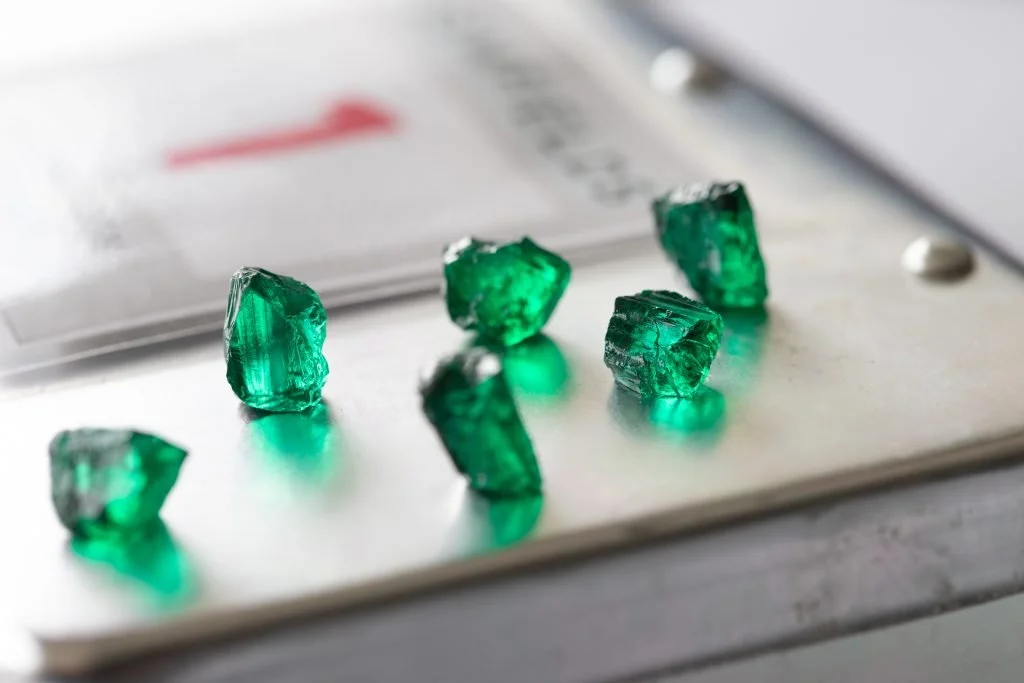
Small Zambian Emerald Parcel: Gemfields
Market Snapshot
China’s jewelry retailers are redesigning their stock around the gram. The World Gold Council’s annual retailer survey, published on October 16 and drawing on 744 store managers and regional heads, shows how far that has gone. Gold jewelry consumption in the first half of 2026 rose 5% in value to RMB144 billion while falling 30% by weight. Together, those figures mean the average price paid for each gram of gold jewelry rose by about half. Customers are spending roughly the same money and taking home far less metal.
Retailers are reshaping their stock to match. 45% plan to reduce gold inventory, more than 40% plan to add pieces under 5 grams, 47% plan to expand the 5 to 10 gram range, and 62% plan to add products with higher labour charges. The logic is margin. When metal is this expensive, a heavy piece ties up working capital in gold that earns the retailer little beyond its weight. A light piece with more design work carries less metal cost and more of the value the retailer actually charges for. Half the responses came from fourth-tier cities and below, so this describes the broad Chinese market rather than Shanghai boutiques.
The holiday trade showed the same pattern at street level. During the National Day holiday, Shenzhen’s Shuibei jewellery district reported sales up 28% year on year and close to 60,000 visitors a day, with lightweight gold and wedding pieces selling best. Shuibei gold was quoted at about RMB1,061 per gram, roughly RMB200 below brand stores. In a price-sensitive market, buyers go where each gram costs least, and buy fewer grams. The 28% is one district in one holiday week with no gemstone figure, so it shows where spending moved, not that it grew nationally.
The World Gold Council’s quarterly update on October 15 explains why this is unlikely to reverse quickly, because it shows Chinese gold buying splitting in two. Gold bought to be made into jewellery is falling: wholesale demand, which mostly reflects jewellery manufacturing, was 234 tonnes in the third quarter, 21% lower than a year earlier and 44% below its ten-year average. Gold bought to be held is rising: Chinese gold ETFs added 27 tonnes to a record 304 tonnes, and the People’s Bank of China bought 63 tonnes, its strongest quarter since 2023. With similar buying elsewhere, these holders are keeping the gold price high, and the person buying a ring pays that price for every gram. While investors and central banks keep buying, gold stays expensive for jewelry customers, and retailers will keep designing lighter pieces. The risk runs the other way too. More than 60% of surveyed retailers believe customers have postponed purchases rather than abandoned them, so a sharp fall in gold would bring some heavier buying back.
What this changes for colored stones is the job a stone does inside a piece. When jewellery is priced mainly on weight, a stone is an added cost on top of the metal. When it is priced on design, a small stone is part of what justifies the price, adding color and perceived value without adding grams. The survey notes that Hard Pure gold already combines gold with enamel, diamonds and other materials. It does not measure gemstone demand, and nothing here points to higher prices for large or premium stones. What it points to is a change in which sizes are wanted: small stones in consistent sizes and colours, available often enough for a manufacturer to build a line around them.
Miner’s Insight
China’s jewelry retailers are redesigning their stock around the gram. The World Gold Council’s annual retailer survey, published on October 16 and drawing on 744 store managers and regional heads, shows how far that has gone. Gold jewelry consumption in the first half of 2026 rose 5% in value to RMB144 billion while falling 30% by weight. Together, those figures mean the average price paid for each gram of gold jewelry rose by about half. Customers are spending roughly the same money and taking home far less metal.
Retailers are reshaping their stock to match. 45% plan to reduce gold inventory, more than 40% plan to add pieces under 5 grams, 47% plan to expand the 5 to 10 gram range, and 62% plan to add products with higher labour charges. The logic is margin. When metal is this expensive, a heavy piece ties up working capital in gold that earns the retailer little beyond its weight. A light piece with more design work carries less metal cost and more of the value the retailer actually charges for. Half the responses came from fourth-tier cities and below, so this describes the broad Chinese market rather than Shanghai boutiques.
The holiday trade showed the same pattern at street level. During the National Day holiday, Shenzhen’s Shuibei jewelry district reported sales up 28% year on year and close to 60,000 visitors a day, with lightweight gold and wedding pieces selling best. Shuibei gold was quoted at about RMB1,061 per gram, roughly RMB200 below brand stores. In a price-sensitive market, buyers go where each gram costs least, and buy fewer grams. The 28% is one district in one holiday week with no gemstone figure, so it shows where spending moved, not that it grew nationally.
The World Gold Council’s quarterly update on October 15 explains why this is unlikely to reverse quickly, because it shows Chinese gold buying splitting in two. Gold bought to be made into jewelry is falling: wholesale demand, which mostly reflects jewellery manufacturing, was 234 tonnes in the third quarter, 21% lower than a year earlier and 44% below its ten-year average. Gold bought to be held is rising: Chinese gold ETFs added 27 tonnes to a record 304 tonnes, and the People’s Bank of China bought 63 tonnes, its strongest quarter since 2023. With similar buying elsewhere, these holders are keeping the gold price high, and the person buying a ring pays that price for every gram. While investors and central banks keep buying, gold stays expensive for jewellery customers, and retailers will keep designing lighter pieces. The risk runs the other way too. More than 60% of surveyed retailers believe customers have postponed purchases rather than abandoned them, so a sharp fall in gold would bring some heavier buying back.
What this changes for coloured stones is the job a stone does inside a piece. When jewellery is priced mainly on weight, a stone is an added cost on top of the metal. When it is priced on design, a small stone is part of what justifies the price, adding colour and perceived value without adding grams. The survey notes that Hard Pure gold already combines gold with enamel, diamonds and other materials. It does not measure gemstone demand, and nothing here points to higher prices for large or premium stones. What it points to is a change in which sizes are wanted: small stones in consistent sizes and colours, available often enough for a manufacturer to build a line around them.
Export & Compliance
No new regulatory change affecting Zambian gemstone exports has been identified since the last brief. The 15% export duty on precious stones and metals remains suspended. Exporters should confirm the current duty, royalty and permit position with MRC or ZRA before each shipment.
The main development is macroeconomics. On October 9, IMF staff and Zambia reached agreement on a new 36-month Extended Credit Facility worth $1.472 billion, subject to prior actions and IMF Board approval. Inflation fell to 6.1% in September and reserves stood at $6.1 billion. Two parts of the programme touch exporters directly. Temporary fuel-tax relief will be reversed, which will raise fuel costs from mine to airport. The program also commits to stronger tax administration and more transparency in mining licensing and beneficial ownership, so license records, production returns and ownership documents are likely to be checked more closely.
The agreement announces no new gemstone tax. Budget for higher fuel costs, keep license and ownership paperwork current, and do not price in a duty that has not been announced.
Opportunity of The Week
The opportunity this week is repeat supply of small, consistent material to buyers serving China’s lightweight jewelry lines, timed for the production season now under way.
Chinese manufacturers are making stock for the year-end peak and for Lunar New Year, which falls on February 6, 2027. Retailers have told the World Gold Council what they want on the shelf: lighter pieces and more design. Every one of those designs that uses a colored stone needs a supply of small stones in matched sizes and colors, ordered in quantity and reordered when the piece sells.
For a Zambian miner, this is the part of the market where being dependable is worth more than being exceptional. Small emerald is plentiful at most mines and often the hardest to sell well, because it is usually offered as a mixed remainder and priced as one. Offered instead as a defined specification (a stated size band and colour range, with an expected monthly quantity), it becomes an input a cutter or manufacturer can plan around. A buyer who can count on the same material next month takes less risk than one searching again each time, and part of that lower risk can come back to the seller as price, or as priority when demand is thin.
Start small. A buyer will want to see one delivery match its description before committing to a second, so the first lot should be modest and exactly as described. Agree the specification in writing, including the size band, colour range, tolerance and how a shortfall is handled, and settle the price only once the second delivery shows both sides can meet the commitment.
The limits are real. Margins on small material are thin, buyers for it in China are mostly cutters and manufacturers rather than retailers, and a fall in gold could pull some demand back toward heavier pieces. This is a steadier outlet for goods that usually sell at a discount, not a new high-price market.
SAVVY is not purchasing stones at this time. We will announce in this brief when purchasing resumes.
Practical Tip
Before your next buyer conversation, write down the size distribution of your smaller material.
Take the parcel you would normally sell as a remainder and divide it into size bands with sieves or a gauge. For roughness, record the weight and number of pieces in each band. For cut stones, record millimetre sizes. Note the colour range within each band in plain terms, and photograph one band at a time in daylight. The result is a one-page sheet: band, pieces, total weight, color range.
Send that sheet with your offer, and ask each buyer two questions: which bands are you short of, and roughly how much of those bands would you take in a month if the color held?
The sheet does three things. It lets a buyer price the parcel on what is actually in it rather than on an assumption, which matters most when the buyer’s own customers order specific sizes. It shows you which bands have a buyer with a defined use and which are genuinely surplus, so you can price them separately. And the buyers’ answers tell you, before you sort another month’s output, which sizes are worth setting aside for repeat sale.
Keep the sheet in the same format every month. If the bands and descriptions stay the same, a buyer can compare this month’s lot with last month’s at a glance, which is the first thing anyone planning a production line will check.