

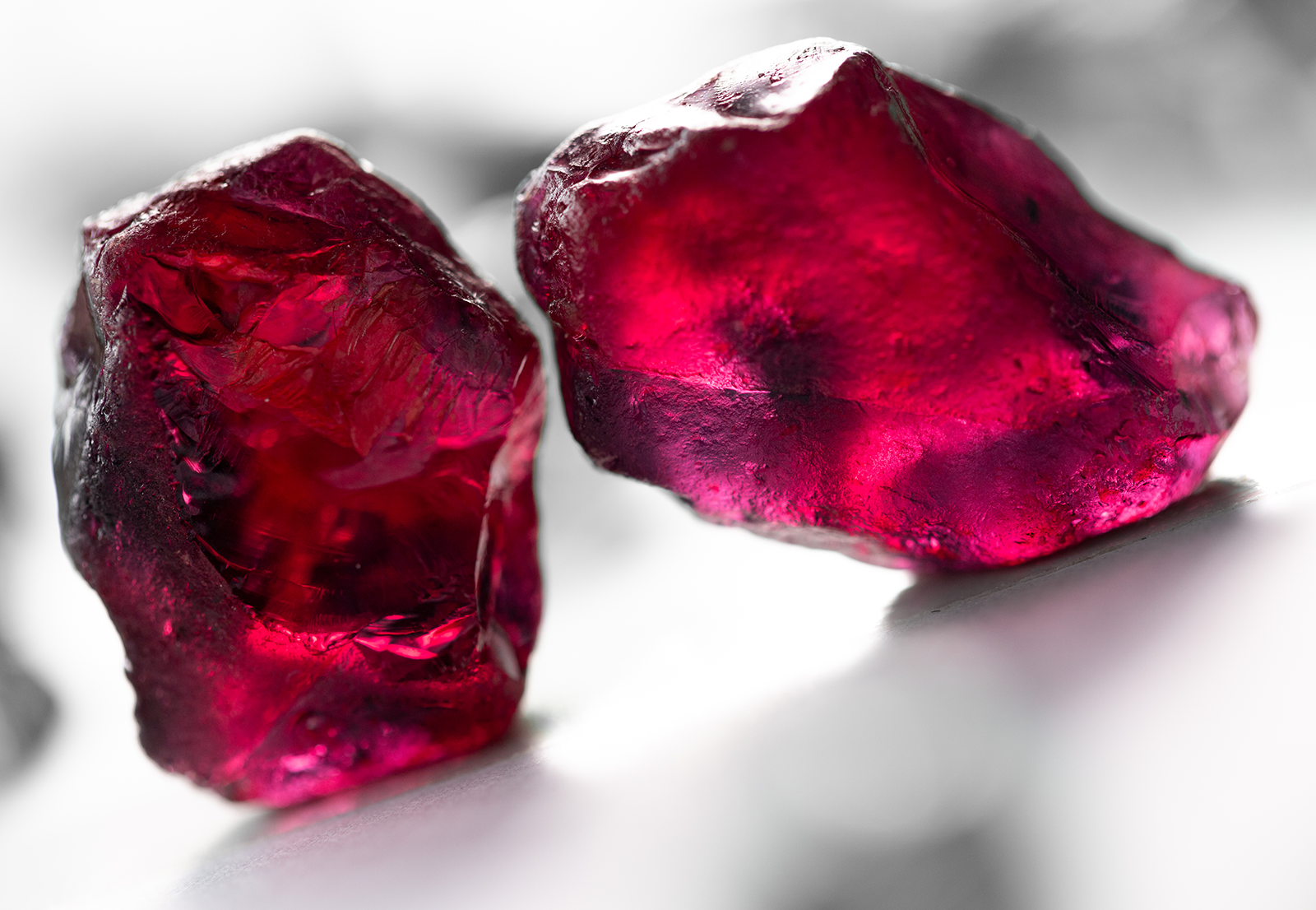
A pair of Mozambique Rubies: Gemfields
Market Snapshot
The change that mattered most for colored-stone pricing in China this period did not come from Chinese demand, which remained weak. It came from the currency in which stones are bought. The yuan reached about 6.65 per dollar at the start of November, its strongest level since April 2022, against 7.12 a year earlier. Because colored stones are generally traded internationally in dollars, the move passes in full to the importer's cost: a parcel invoiced at $10,000 now costs a mainland buyer about RMB66,700, against RMB71,200 a year ago, roughly 6% less with no change in the seller's price. The mechanism works in both directions. In May, Gemfields named the Indian rupee's 10% fall against the dollar as a headwind for buyers at its higher-quality Kagem emerald auction.
The People's Bank of China has now signaled a limit. On November 3, it raised the share of foreign-currency deposits that banks must hold in reserve from 4% to 6%, effective November 15, its first increase in nearly five years. The yuan fell 0.3% to about 6.67 that day, its largest one-day decline in six months. The measure tightens onshore dollar liquidity to slow appreciation rather than reverse it, so most of the past year's gain is likely to hold, but further gains should not be assumed. The main external risk runs through Washington: by November 5, markets priced in about an 80% chance of a US rate rise in December, which would tend to strengthen the dollar against the yuan and weigh on gold at the same time.
Cheaper imported inputs have not lifted volumes, and spending itself is now falling. Our previous brief described customers spending about the same money on less metal; that held for the first half as a whole, but official retail sales of gold, silver and jewellery fell year on year in April, May, June, July and September, most recently by 9.6%. The World Gold Council reported on November 3 that Chinese gold jewellery consumption fell 22% in the third quarter to 66 tonnes, the weakest third quarter since 2006. Gold fell to a one-year low of $3,869.85 an ounce on October 30, its weakest October since 2008, as markets began to price a US rate rise, and ended the week near $4,050, about RMB870 a gram for bullion, roughly 3% below mid-October. That is too small a move to undo the shift to lighter pieces, and there is no reliable sign yet of heavier buying: the only October store reports mainly reflect the National Day holiday covered in our last brief.
Hong Kong shows where the currency gain is being spent. Sales of jewllery, watches and valuable gifts there rose 20.3% year on year in September, with mainland visitors up 29%: the Hong Kong dollar is pegged to the US dollar, so mainland shoppers' yuan buys about 6% more than a year ago, with no VAT. Two limits apply. September was lifted by the Mid-Autumn holiday, which fell in October last year, and mainland residents can bring back only RMB12,000 of goods duty-free, so the effect is concentrated in smaller pieces.
Miner’s Insights
In July we described Gemfields' new Trade Select format as a response to falling premium recoveries at Montepuez, and said the October ruby auction would be the next real price signal. That auction, announced on October 19, raised $52.0 million: 90% of the 102,099 carats offered sold at an average of $564.54 per carat, the highest Gemfields has recorded at a mixed-quality ruby sale. February's equivalent sale raised $53.0 million at $279.39 per carat from roughly twice the carats.
Most of the difference is composition, not price. Lower grades now go through Trade Select, which sold 348,409 carats at $66.30 in June; June and October together average about $170 per carat, and all three 2026 sales about $203. What the result confirms is the scarcity our October 2 brief described after Gemfields' $125.2 million write-down: buyers paid the strongest prices for larger fine rubies, and October's offer, at just over 20 kilograms, was smaller than in earlier years.
The new information is how the two largest producers are responding to the same weak Chinese demand. De Beers cut prices in July and sold 71% more carats in the third quarter for only 4% more revenue, at an average of $84 per carat, 45% below a year earlier; Rapaport reported on November 3 that October sales were low as buyers had bought ahead. The diamond producer traded price for volume; the ruby producer traded volume for price. The likeliest reason is substitutes: laboratory-grown diamonds cap natural diamond prices, while fine colored stones have no close equivalent at the top of the market.
For independent producers, that cuts two ways. Holders of fine ruby face less competition from the largest source. Holders of commercial ruby face more: Gemfields now runs a regular volume channel, with the next Trade Select sale in December, giving buyers of lower grades more choice and more reason to bargain. For emerald, the equivalent test is Kagem's higher-quality auction scheduled before year-end; May's sale averaged $146.08 per carat.
Export & Compliance
Zambia's 2027 Budget, presented on November 6, raises several costs for licensed producers from January 1, subject to National Assembly approval. License fees and area charges for mining, exploration and mineral processing will rise. Withholding tax on dividends paid by mining companies goes from 0% to 15%, so for a company paying the standard 30% corporate tax, the total tax on profits it distributes rises from 30% to about 40.5%. VAT rises to 16.5%; this matters little to VAT-registered exporters, whose exports are zero-rated, but is a straight cost for small producers below the registration threshold.
The only mining relief is for gold: small-scale miners selling to approved aggregators will pay a 3% royalty instead of 6%. Gemstone royalties and export rules are unchanged.
The fuel-tax reversal flagged in our last brief is under way: excise duty returned in October, and November pump prices rose again, to K33.06 for petrol and K34.45 for diesel. VAT on fuel returns on December 1, so budget for higher transport costs.
Opportunity of the Week
The opportunity this season lies with buyers whose costs have fallen or whose customers are spending: mainland retailers and manufacturers selling in yuan, and Hong Kong retailers serving mainland visitors.
As our last brief noted, gem-set stock for Lunar New Year, on February 6, 2027, is ordered and made in the coming weeks. A mainland buyer selling in yuan pays about 6% less for a dollar-priced stone than a year ago and, because its customers also pay in yuan, can meet last season's dollar price while spending less. A Hong Kong retailer gains differently: its costs are unchanged in Hong Kong dollars, but its mainland customers' yuan now buys about 6% more and visitor numbers are rising. Mainland residents can bring back only RMB12,000 of goods per trip duty-free, so the gain is concentrated in smaller pieces. Both are better placed than manufacturers exporting to the United States or Europe, whose dollar revenue now converts into fewer yuan and who will push hardest for discounts.
The specification approach in our last brief still applies; what changes is who to offer it to first. First, segment buyers by where they sell, not only by what they buy, since the same parcel now meets very different budgets. A buyer supplying counters or brands in China and planning holiday designs is selling at home; one discussing overseas orders and shipping deadlines is exporting. Second, hold dollar prices with domestic-market and Hong Kong buyers, where the currency has already lowered the buyer's cost, and concede on terms instead, such as firmer delivery dates. Third, producers in Zambia are on the other side of the same move: at 20.62 per dollar in early November, a dollar buys about 9% fewer kwacha than a year earlier, while fuel costs are rising now and taxes in January. A discount in dollars would hand buyers a second gain at the producer's expense.
The limits are real. Volumes remain weak, the central bank is leaning against further yuan gains, and October's Hong Kong figures will lose the holiday boost. This is a better season in which to defend prices, not a rising market.
SAVVY is not purchasing stones at this time. We will announce in this brief when purchasing resumes.
Practical Tip
Before your next offer, calculate three numbers and keep them on file with it.
First, your cost per carat in local currency: last month's costs, including fuel, wages, licenses, royalty and transport, divided by the sellable carats produced. A month costing K150,000 that yields 500 carats gives K300 per carat. This is an average; better material should carry more than its share, and commercial goods may sell below it.
Second, your dollar floor: that cost divided by the central bank's reference rate on the day of the offer. At 20.62 kwacha per dollar, K300 per carat is about $14.55; a year earlier, at 22.59, the same cost required about $13.28. The floor moves with the currency, so recalculate it before each offer.
Third, the buyer's cost: your dollar price multiplied by the buyer's exchange rate. You will not share it, but when a buyer argues that the market has fallen, it shows what the parcel costs them compared with a year ago.
The firm, dated offers recommended in our October 2 brief now need one more line: the exchange rate on the day of the offer. A dollar price agreed today and paid three weeks later can be worth several per cent more or less in local currency; on October 6 the kwacha fell 6% within a single session before recovering most of the loss.
Finally, keep a simple log of offer date, dollar price, exchange rate on that date, payment date and rate on that date. After a few sales it separates what the stones earned from what the currency did, which is what you need to know before accepting any lower price.