

August Week 2 Market Brief
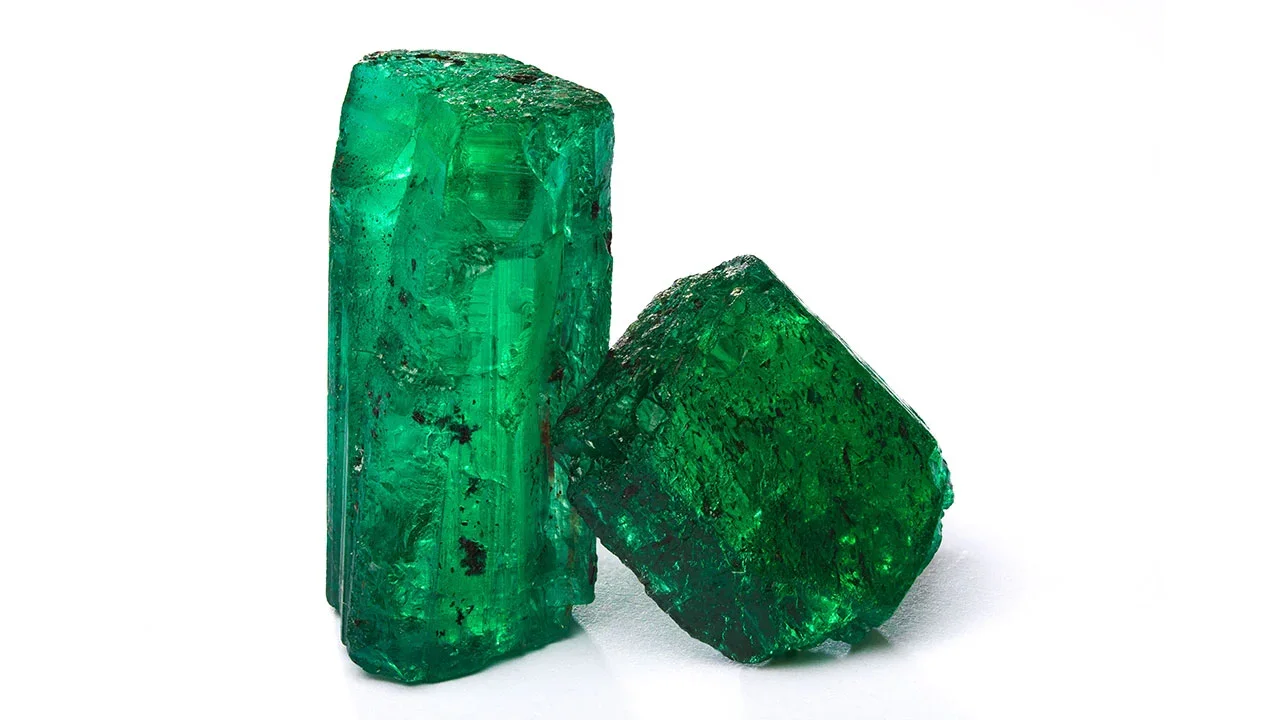
Premium Emerald, Image Courtesy from Rapaport
Market Snapshot
Gemfields reported on July 30 that its auction revenue for the first half of 2026 rose 72% to $102.9 million. Read alone, that number looks like recovery. The comparison base is H1 2025, when Kagem was suspended from January through April, so a large increase was arithmetically likely before any change in demand. The operational disclosures underneath the headline carry more information, and set alongside two other developments from the past three weeks they describe something narrower: three of the arguments that normally lift the price of a Zambian emerald are weakening at the same time.
Within that $102.9 million, the May Kagem emerald auction contributed $26.8 million at an average of $146.08 per carat, with 36 of 37 lots and 99% of carats sold. Gemfields described premium emerald production at Kagem as healthy through the period, while noting that operating costs rose on fuel prices, exchange rate pressure and increased mining activity. At Montepuez, premium ruby recovery held at 0.025 carats per tonne even as the second processing plant contributed meaningfully to overall volumes. That last detail matters more than it appears. Additional processing capacity can increase the material handled but cannot create premium grade where the ore does not contain it, which makes the ruby constraint geological rather than operational. Emerald is telling a different story. Healthy Kagem output does not prove that no Zambian emerald is scarce, and exceptional material remains genuinely rare. Eshed-Gemstar disclosed on August 12 that the 104-gram Kagem rough it bought at that same May auction was purchased at a record per-gram value for Zambian rough above 100 grams, on the expectation of yielding no-oil investment-grade stones. What healthy output does mean is that a seller cannot assume a general scarcity premium, because the buyer knows comparable premium material continues to reach the market. Rising producer costs do not resolve this either. Costs influence how much supply eventually comes forward and how firmly a producer resists discounting, but they do not oblige a buyer to pay more.
The demand side, reported by the World Gold Council on August 14, complicates the picture further. Chinese wholesale gold demand fell 8% month-on-month in July, reflecting continued weakness in the jewellery sector. Over the same month Chinese gold ETFs added 5 tonnes to reach 282 tonnes, with inflows on almost every trading day so far in August, and the People's Bank of China bought 20 tonnes, its largest monthly purchase since late 2023 and a twenty-first consecutive month of accumulation. These are different buyers with different motives and should not be collapsed into a single story about the jewellery consumer. What they show together is that capital retains strong appetite for precious assets where liquidity and benchmark pricing exist, while jewellery-linked physical demand stays soft. The consequence reaches a Zambian miner through the dealer. For a Chinese buyer, the alternative to committing capital to an emerald parcel is not necessarily a different emerald parcel. It may be keeping that capital liquid, increasing gold exposure, or waiting for material with a faster resale path. Loose coloured stones carry wider valuation dispersion than bullion, require cutting and often certification before reaching a final customer, and can sit on a balance sheet for months. When capital has more liquid alternatives, those costs and uncertainties are priced into the bid on rough.
The third development concerns the language that premiums are built on. On July 23 the CIBJO Coloured Stone Commission confirmed that from September its Blue Book will permit only the term synthetic for man-made stones. More consequentially for natural material, commission president Charles Abouchar warned that a ruby described as pigeon blood on a laboratory report commands a premium price despite the term not being an international standard, leaving a client who does not know this to pay an unjustified price, and observed that new colour names appear every year to the benefit of laboratories and some clever dealers. CIBJO is also developing a Valuations Guide. This does not remove premium terminology from the trade, and CIBJO does not impose a compulsory global pricing system. What it does is increase scrutiny over how much of a premium rests on observable quality and how much rests on a description whose meaning may vary between laboratories and markets. That uncertainty travels upstream. A cutter bids on rough according to the expected value of the finished stones recoverable from it. Where part of that expected value depends on receiving a particular laboratory description, and confidence in that description weakens, the buyer discounts the rough for the possibility that the finished stone does not receive it. The effect is sharpest in China, where buyers rely heavily on colour trade terms and routinely send foreign-certified stones to NGTC for verification.
Taken together, this week's data does not support another conclusion that premium wins. General scarcity is not available to Zambian emerald. Broad demand recovery is not arriving, because capital has credible alternatives to gemstone inventory. Grading language is under scrutiny from the industry's own standards body. What replaces those three arguments is not a fourth argument. It is a discount. The variable that now moves most in a negotiation is how much uncertainty the buyer is pricing into the bid, and that is the one part of this equation partly within a seller's control. The July brief described a split between premium and commercial demand. The current data suggests a second filter forming inside the premium category itself, sorting not by quality but by how reliably that quality converts into a price the buyer can defend.
Miner’s Insights
The commercial consequence is that the arguments a Zambian miner can credibly make in a negotiation have narrowed, and the variable that has replaced them is one most sellers never name. It is the buyer's discount.
A Chinese dealer does not begin at the retail value of a finished emerald and work backward mechanically. The bid on rough has to absorb expected cutting loss, labour, certification, financing, holding time, the possibility that the finished stone grades below expectation, and the margin required by the next participant in the chain. Every uncertainty between the mine and the resale is deducted somewhere. When jewellery demand is soft and capital can sit in more liquid assets instead, buyers have less reason to absorb those uncertainties without compensation.
This is why the Kagem data needs reading carefully rather than optimistically. Healthy premium emerald production is positive for the continued relevance of Zambian material, but it also means independent miners are operating beside a large supplier still bringing premium goods to market. Nothing in the July 30 update suggests premium emerald availability has weakened the way premium ruby grade has at Montepuez. Anchoring an asking price to the assumption that all premium coloured stones are becoming scarce is therefore a claim a buyer can check and dismiss, and dismissing it costs credibility on everything else said in the same conversation.
The stronger position is to demonstrate why a specific stone or parcel deserves a smaller discount than competing emerald supply. For rough emerald that means concentrating on the characteristics that affect conversion rather than on broad adjectives. Colour matters, but so do crystal formation, visible fissures, size distribution, consistency across the parcel, and how confidently a buyer can estimate the range of finished outcomes. A homogeneous parcel gives a clearer basis for estimating yield and resale than a mixed one containing a few exceptional stones and a long tail of uncertain material. The financial logic is simple. The greater the uncertainty around the final outcome, the larger the return a buyer needs in order to accept it. Reduce the uncertainty and the buyer has less economic reason to demand as large a discount.
The CIBJO development reinforces the same principle from a different direction. A premium descriptor on a future laboratory report is worth something only to the extent that the buyer believes the next market will recognise it. Where terminology varies between laboratories, or is explicitly treated as opinion rather than standard, the buyer has to account for the possibility that the anticipated premium never materialises, and that possibility is transmitted backward into the price offered for the rough. Miners do not need to become laboratories. They do need to understand which characteristics the buyer is underwriting and which assumptions are carrying the offer.
The most useful question in this market is therefore no longer what the market price is for a given quality. It is what uncertainty the buyer is discounting from this stone, and whether any of it can be removed. Better sorting reduces quality uncertainty. Clear measurements and consistent presentation reduce assessment uncertainty. Reliable records reduce provenance uncertainty. Separating an exceptional stone from weaker parcel material prevents its value being averaged downward. None of these actions creates geological quality. Each of them determines how much of that quality survives into the negotiated price.
The seller in the strongest position is not the one claiming the rarest material. It is the one whose material is easiest to verify, model and resell.
Export & Compliance
No new regulatory change affecting Zambian gemstone exports has been identified. The 15% export duty on precious stones and metals remains suspended, though exporters should verify the current duty, royalty and permit position directly with MRC or ZRA before shipment. Mineral analysis, royalty clearance, production records and security clearance remain required before goods leave the country.
Traffic through the Strait of Hormuz remains volatile rather than recovering. Daily vessel counts have improved from recent lows but stay below the month's average, attacks on commercial shipping have continued, and the naval blockade may remain in place while ceasefire talks stall.
For shipments routed through Gulf transit hubs the operational signal is the volatility itself, not the direction of any single day's count. A better week does not remove the risk premium while control of the waterway is contested. Do not commit to a China delivery date against an old freight quote. Recheck routing, carrier availability, total logistics cost and timing immediately before the stones leave origin, and treat any schedule dependent on Gulf transit as provisional until the carrier confirms it.
Opportunity of The Week
The strongest opportunity this week is to make premium material easier to underwrite.
Last brief’s opportunity was collection-ready supply for confirmed design-led buyers. This is the mechanism underneath it. A Chinese buyer committing capital to a rough parcel is accepting a set of uncertainties at once: yield, finished quality, the time the stones sit before resale, and whether the eventual laboratory description supports the price paid. With jewellery demand soft and liquid alternatives available, each of those uncertainties costs the seller more than it did a year ago. The opportunity is to remove as many as possible before the price conversation begins.
Two moves do most of the work. The first is to build the sales case on characteristics that survive scrutiny rather than on descriptions that may not. Treatment status established by testing. Recovery origin recorded honestly. Colour described through saturation and consistency the buyer can see. CIBJO's review signals that the trade is becoming less comfortable with premiums resting on terminology alone, and a seller already grounded in observable fact will not have to change position as that conversation develops. The Legacy Emerald is the evidence for where value sits: a record per-gram price for Zambian rough was paid on the expectation of no-oil investment-grade output, assessed physically, not on a colour designation.
The second is to reduce the size of the buying decision. A tightly sorted parcel of colour-consistent emerald within a narrow quality band gives a buyer a clear basis for estimating yield and resale. Adding weaker material raises the invoice, but it also raises the capital tied up in stones the buyer did not principally want, and in a cautious market that weakens the bid on the entire parcel. Keep secondary material available. Do not require a buyer to purchase it in order to reach the premium stones.
Sell concentration rather than volume. Where capital is selective, reducing the ambiguity of the buying decision is worth more than increasing its size.
Practical Tip
Take your best parcel and split what you know about it into two columns. In the first, everything you can physically prove: weight, dimensions, number of pieces, size range, recovery location and date, treatment status if it has been tested, and colour consistency you can demonstrate by laying the stones out together under the same light. In the second, everything you are currently asserting: a quality tier, a colour name, a comparison to another stone, an expected yield.
Most sellers have a short first column and a long second one. The second column is the part a buyer discounts.
The highest-value action available this month is to establish and record treatment status on your best material, and to write down exactly where and when it was recovered. Treatment status is a physical fact rather than an opinion, which means it does not depend on which laboratory issues the report or on how colour terminology develops from here. It is also what carried the Legacy Emerald into record territory, where the price was paid on the expectation of no-oil investment-grade output.
When the first column is longer than the second, you are ready to open a price conversation. Until then, every negotiation begins with the buyer testing claims you cannot support, and each one they knock down lowers the anchor for everything that follows.
This brief will be published biweekly.