

April Week 4 Market Brief
April 2026 — Week 4
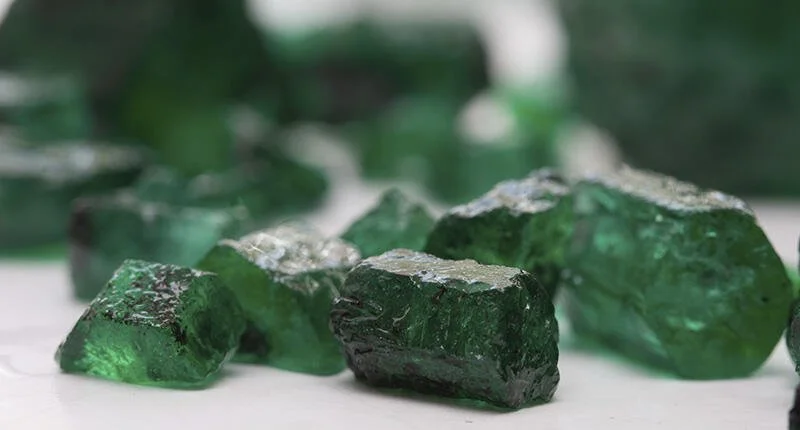
Rough Zambian Emeralds from the Kagem Mine
Image courtesy of National Jeweler
Market Snapshot
The Chinese colored gemstone market remains active but increasingly selective, with a clear polarization by quality. Demand is concentrated in investment-grade stones—those with strong color, clarity, and reliable documentation—while commercial-grade material continues to face higher price sensitivity and more cautious buying behavior.
On the supply side, Gemfields’ Kagem mine generated $84.1M in auction revenue in 2025 and paid $4.9M to the Zambian government, broadly in line with $81.7M in 2024 despite a full suspension of mining from January through April 2025—demonstrating underlying market resilience. At the emerald commercial tier, pricing has recovered meaningfully: the December 2025 auction achieved an average of $7/ct, up from $4.47/ct at the September 2024 equivalent auction, a 56% increase that confirms the clearance of prior oversupply.
Current pricing benchmarks indicate a stabilized recovery. Commercial-quality Zambian emerald rough is trading in the $7–7.50/ct range, while premium-quality rough has rebounded to approximately $160/ct, recovering from $113/ct in November 2024. Looking ahead, a return of Kagem’s G-Factor toward its long-term average of ~18% would imply government revenues rising from $4.9M toward $15–18M annually, contingent on total auction revenues recovering toward the $100M+ level. This, in turn, depends on premium pricing sustaining above $150/ct and trending toward the $167/ct peak achieved in May 2024.
The recovery is driven by a clear market rebalancing. The temporary suspension of mining reduced new supply, while continued auctions allowed excess inventory to be absorbed. By late 2025, buyers were no longer operating in an oversupplied environment, restoring pricing discipline across auctions. In parallel, the suspension of the 15% Zambian export duty removed a significant cost constraint, improving the competitiveness of Zambian emeralds relative to other origins.
The most likely window for the next meaningful price signal is mid-2026 — Gemfields' next higher-quality Kagem emerald auction. If the mid-2026 higher-quality auction holds at or above $160/ct, it confirms the recovery is durable and sets the price floor for the second half of the year.
At recent auctions by Gemfields, average ruby prices reached ~$279/ct (2026), pulled down by lower-grade material. Fine-quality, unheated African rubies maintained strong premiums, with pricing ratios up to 8:1 vs. commercial-grade stones. Chinese demand for commercial-grade rubies was weak, confirming limited appetite outside the premium segment.
What This Means for Zambian Miners
Buyers, particularly in China, are increasingly using Gemfields as a benchmark for trust, raising expectations around transparency and traceability. Even high-quality stones can be priced closer to lower-tier material if they are not properly documented.
Certification and traceability are critical to accessing existing premiums. For example, a 4.58 ct vivid green, no-oil Zambian emerald with certification has been listed at approximately US$53,429, or US$11,666 per carat. In contrast, across open marketplaces such as GemRock Auctions, emeralds are listed anywhere from around $10/ct to over $3,000/ct. This wide pricing dispersion reflects uncertainty around origin, treatment, and overall quality when stones are not formally documented.
At the same time, the Chinese market is becoming more segmented. A confident high-end segment continues to pay for top-quality stones, while a more price-sensitive segment remains cautious and slower to transact.
For miners, this reinforces the need to differentiate material. High-quality emeralds, sapphires, and strong-color aquamarine should be directed toward premium buyers, with emphasis on certification, presentation, and smaller, well-prepared parcels. Lower-grade material, by contrast, is likely to face slower sales and tighter pricing conditions.
For further information about aquamarine pricing refer to our previous article.
Export & Compliance Update
Due to the closure of the Strit of Hormuz, longer rerouting adds days to transit times and increases fuel surcharges on air cargo. For gemstone parcels, which are almost exclusively shipped by air due to their high value-to-weight ratio, this means two things: transit times from Lusaka to Guangzhou or Shanghai are currently longer than normal, and the per-shipment cost is higher than it was three months ago.
Miners should build extra lead time into any delivery commitments made to Chinese buyers right now, and confirm current DHL rates before agreeing to shipment cost splits with buyers. If Iran ceasefire negotiations progress, costs should ease, but a full return to pre-war logistics pricing could take months.
Opportunity of the Week
As Chinese demand becomes more polarized, well-documented, high-quality stones, particularly Vivid Green and Verdant Green emeralds, Pigeon Blood rubies, Cornflower Blue sapphires, and strong-color Santa Maria aquamarine above 1 carat, continue to attract active and confident premium buyers. By prioritizing certification, traceability, and tighter sorting into smaller, high-quality parcels, miners can access these higher-value segments, while avoiding the pricing pressure affecting undifferentiated or lower-grade supply.
For emeralds, miners holding well-sorted, strong-color premium rough should begin preparing material for the mid-2026 auction window. Current pricing recovery and improving market balance point to the early stages of a stronger pricing cycle, with early participants better positioned to capture renewed buyer competition. Delaying into the second half of the year may reduce exposure to this initial phase of price recovery.
SAVVY currently has the ability to purchase high-quality premium and good quality rough material that is readily available in China.
Practical Tip
Separate and present your top-quality stones differently from the start. Keep high-grade material in smaller, well-sorted parcels and ensure each stone is supported by clear origin and quality documentation before offering it to market. This simple step helps position your best stones directly toward premium buyers, rather than having them priced alongside mixed or lower-grade material.
Closing
We continue to provide gemstone and jewelry market intelligence relevant to the Zambian gemstone mining and trading industry, with the goal of improving information flow, market understanding, and trade facilitation.
This briefing will be published every Friday.